Beyond market logic
N°11 - October 2025

As October unfolds, this edition reveals how markets are navigating the gap between what can be measured and what can be sustained.
Wealth concentration shows new patterns. Andre Tartar reports US millionaire households reached 24 million, yet 66% of barely-millionaires’ wealth remains locked in homes and retirement accounts with HELOC rates doubling since 2022. Meanwhile, European pension funds allocate just 0.12% of €3 trillion to venture versus 10% for US peers, constraining deal activity towards 2016 lows as resource constraints prevent adequate due diligence.
Governance structures reveal critical vulnerabilities. Andre Retterath’s analysis shows only 34% of startups add independent directors by Series A despite evidence they raise larger rounds and drive higher IPO rates. Investor-dominated boards deliver faster but lower-value exits with reduced innovation, whilst FTX-style collapses demonstrate catastrophic risks when oversight remains absent.
Technology investment faces credibility questions. Christopher Beam reports Big Tech’s $371B data centre spending projects an $800B annual revenue shortfall by 2030, with 95% of corporate AI projects showing no measurable returns. GPU depreciation after just years creates a “hamster wheel” unlike lasting railway infrastructure, whilst energy bottlenecks delay completion by up to eight years.
Energy transitions show divergent paths. Australia’s grid reached 77% renewable generation peaks through market forces, while China invested $625B annually, reshaping renewable prices despite modest emission reduction commitments. Yet carbon offset mechanisms show deep flaws: Audrey Garric reveals carbon credits systematically fail with unprovable additionality and impermanent storage.
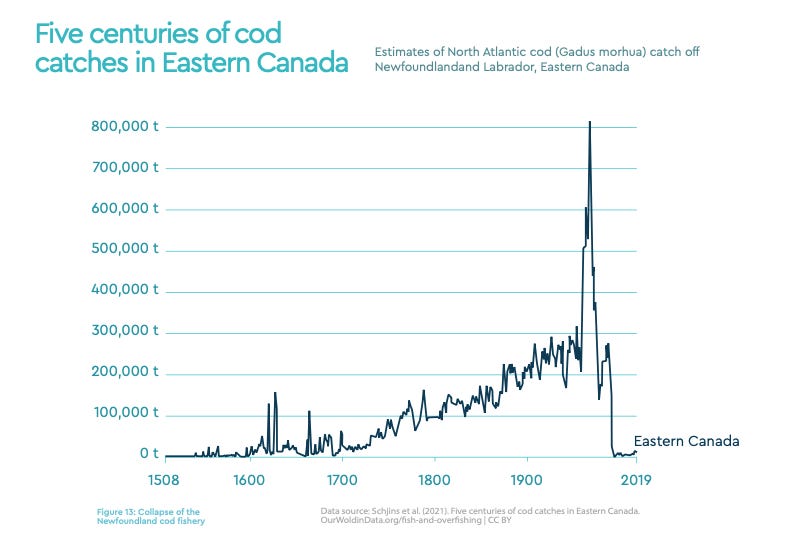
Natural resource management offers proof that constraints work. Florence Santrot documents how scallop abundance reached exceptional levels through decades of catch restrictions, with similar success appearing in Brittany lobster and bluefin tuna recovery. The featured graph reinforces this lesson through contrast: Newfoundland cod collapsed from 800,000 tonnes to near-zero within years, showing limited recovery despite three decades of fishing moratoriums.
We hope this curation will drive your own reflections and actions. Please feel free to share it with those who might be interested.
Let’s dive in! 💫
Insights
Andre Tartar, Ben Steverman, and Stephanie Davidson 🇺🇸 report that US millionaire households surged to 24 million (one in five households) by 2023, with a third created since 2017, yet 66% of barely-millionaires’ wealth is locked in primary homes and retirement accounts compared to 24% liquid assets for $5M+ households. Bloomberg analysis shows higher interest rates compound liquidity constraints with HELOC rates at 7.89% (double 2022 levels) and margin loans at 10-11%, while the cost of an affluent New York lifestyle jumped from $1.4M to $2.1M since 2017, prompting advisers to suggest $10M as the new millionaire threshold. | Bloomberg - WEALTH
Leah Hodgson 🇬🇧 reports European pension funds allocate only 0.12% of €3 trillion assets under management to VC versus 10% for US peers, constraining Europe’s venture ecosystem as deal activity heads toward 2016 lows. The PitchBook analysis attributes the gap to resource constraints preventing due diligence, perception that VC carries higher risk than data suggest, and €50M median fund sizes too small for efficient institutional deployment, though UK’s Mansion House Accord and France’s Tibi initiative raising €12.5B since 2020 signal emerging momentum. | PitchBook - VC
Ludovic Subran 🇫🇷 outlines a three-horizon private equity outlook with Horizon 1 (1-2 years) marked by tighter fundraising and selective deals in tech, healthcare, and infrastructure as firms prioritise exits and portfolio management. Allianz’s Chief Investment Officer projects Horizon 2 (3-5 years) bringing industry consolidation with leading funds capturing disproportionate commitments and innovation in continuation vehicles and semi-liquid retail structures, while Horizon 3 (5-10+ years) could see private markets surpass $10T AUM with mega-firms scaling across asset classes, AI-driven decision-making, and Asian expansion blurring public-private market lines. | LinkedIn - PE
Andre Retterath and Jerome Jaggi 🇩🇪 reveal that only 34% of startups add independent directors by Series A despite evidence showing they raise larger follow-on rounds and have higher IPO probability, with optimal governance requiring 1-2 independents rather than VC-dominated boards. Their analysis of 5,562 European ventures and US data shows investor-heavy boards drive faster but lower-value exits with reduced innovation (fewer patents), while non-investor operator-directors increase IPO likelihood and R&D investment, with truly independent directors serving as force multipliers bringing new investors, executives, and acquirers while preventing governance failures like FTX’s collapse. | Data Driven VC - BOARD
Christopher Beam 🇺🇸 questions whether Big Tech’s $371B data center spending in 2025 can ever generate sufficient returns, with Bain & Co projecting an $800B annual revenue shortfall by 2030 despite AI’s current $60B revenue. The Bloomberg Businessweek analysis draws parallels to the 2000 telecom bubble that lost $500B, highlighting MIT findings that 95% of corporate AI projects show no measurable returns, while GPU depreciation after just years creates a “hamster wheel” dynamic unlike lasting railroad or fiber-optic infrastructure, and energy bottlenecks delay data center completion by up to 8 years. | Bloomberg Businessweek - AI
Julian Spector 🇺🇸 reports Australia’s National Electricity Market reached 77% renewable generation for a half-hour period with coal dropping from dominance to 46% as the aging fleet retires, targeting 90% coal elimination by 2035 driven by market forces rather than mandates. The WIRED analysis highlights Australia’s unique advantages including highest rooftop solar penetration globally (4 million homes temporarily supplying 55% of demand) and deployment of synchronous condensers with gas plant clutches to provide grid stability services like voltage support and fault current as coal plants disappear, with projects like Hydrostor’s Broken Hill compressed air facility contributing spinning mass for grid security. | WIRED - ENERGY TRANSITION
Antonio Piemontese 🇮🇹 reports China committed to reducing emissions for the first time after decades of growth-only pledges, while investing $625B in clean energy last year, nearly one-third of global total. The WIRED Italia analysis shows China’s massive domestic market and research capacity have reshaped global renewable prices dramatically, though its annual emissions decline pace trails major European nations, with Xi’s commitments contrasted against US Paris Agreement withdrawal and EU divisions leaving Beijing as default climate leader despite modest targets. | WIRED Italia - CLIMATE POLICY
Audrey Garric 🇫🇷 reports that carbon credits systematically fail to reduce global warming with climate impacts vastly overestimated, as a Nature meta-analysis shows only a small fraction of credits generate real emission reductions. The review of 200+ studies by Joseph Romm reveals “deeply rooted systemic problems” including unprovable additionality when projects would have happened anyway, emission leakage as deforestation simply shifts locations, and impermanent storage with most tree-planting organisations failing to track survival rates, while COP29’s 2024 market reforms maintain problematic features lacking enforcement mechanisms. | Le Monde - CARBON CREDIT
Mathilde Gérard 🇫🇷 reports the EAT-Lancet Commission’s study showing food systems drive five of nine planetary boundary breaches while the wealthiest minority causes most food-related environmental impacts, yet billions lack access to healthy food. The Lancet research proposes a plant-forward dietary shift reducing meat consumption could prevent millions of premature deaths annually, with investment costs vastly outweighed by health savings and ecosystem regeneration returns, though economists like Raj Patel warn political proposals remain “naïve” without addressing power concentration in agricultural supply chains where many workers earn below minimum living wages. | Le Monde - FOOD SYSTEMS
Florence Santrot 🇫🇷 reports that scallop fishing demonstrates sustainable practices work, with resource abundance at exceptional levels after decades of catch restrictions since the 1990s, enabling the 2025 season to start earlier than usual on October 1st. The We Demain interview with Poiscaille founder Charles Guirriec highlights how diving-method harvesting respects seabed habitats for around €4.50/kg versus €2/kg for dredging, while noting commercialization challenges from price competition with imported “water-inflated” scallops and unrestricted foreign fleets fishing French zones, though similar restriction success appears in Brittany lobster and bluefin tuna recovery showing regeneration potential when pressure limits apply. | We Demain - FISHING
Graph of the week
This graph from the Introduction to the Ocean shows the catastrophic collapse of Newfoundland cod fishery, with catches peaking above 800,000 tonnes in the early 1990s before plummeting to near-zero by mid-decade. The data from 1508 to 2019 shows how centuries of gradual exploitation intensified with industrial fishing, exceeding ecosystem capacity and triggering sudden collapse in 1992.
Despite three decades of fishing moratoriums, cod populations show limited recovery, demonstrating how crossing ecological boundaries causes irreversible damage with cascading consequences for coastal communities. The fishery’s failure reminds us that natural systems have absolute limits, and ignoring these boundaries, even when profitable for generations, can destroy resources within a decade.