Beyond tensions: charting alternative paths
N°21 - May 2026

Once again, global news is centred on the three key tensions of the ‘permacrisis’: geopolitical instability, the consequences of exceeding planetary boundaries and the AI boom reshaping the economy and the job market.
We tend to think that what happens in one part of the world only has an impact on that region. What more can be said about planetary boundaries that we do not already know? Perhaps to highlight that time is flying by.
A few years ago, when we talked about the consequences of these limits, we thought it would be ‘in the future’, some of us didn’t feel it concerned us. Spoiler alert: we’re living through them now. The Colorado River is at its lowest level and Corpus Christi is facing complete drying up next year.
Now, AI is challenging white-collar jobs. If this technology isn’t used to create a fertile future, then we’re in trouble.
But tensions reshapes our view of the world and pushes us to think differently. Could we have predicted that, within an investment fund, people would speak on behalf of Nature?
Between tensions and transformations, this edition reminds us that navigating the permacrisis requires both lucidity when facing crises and attention to the emerging paths for surpassing them.
Share it with anyone who needs it.
Meyha
Insights
Miles J. Herszenhorn 🇺🇸 documents how the US-Israel war with Iran has triggered the worst energy shock in decades, with global ripple effects hitting small businesses across the world.
Miranda Bryant & Jillian Ambrose 🇬🇧 report that Norway’s government faces fierce backlash for approving plans to reopen three North Sea gasfields closed since 1998 and explore 70 new locations to fill energy supply gaps created by the Middle East war.
Molly Taft 🇺🇸 warns that America’s water crisis becomes real this summer as the Colorado River hits record lows threatening 40 million people, while Corpus Christi faces potential Day Zero next year.
Dorothée Browaeys 🇫🇷 interviews Sénamé Koffi Agbodjinou on his role as Nature’s guardian at 2050 fund and what it actually means to “speak for nature” inside an investment fund.
Chris Stokel-Walker 🇬🇧 reports on how Swedish researcher Almira Osmanovic Thunström invented a fake disease called “bixonimania” to test AI systems, and major chatbots including ChatGPT, Gemini, and Copilot began citing it as real within weeks.
Dan Gray 🇬🇧 analyses Stanford research showing venture capital’s traditional 10-year fund structure has collapsed, with most 2010-2014 funds still holding more unrealised value than their original size at year ten instead of returning cash to investors.
Melissa Bruntlett & Chris Bruntlett 🇨🇦 argue that cities thrive under female leadership through radical empathy and inclusive urban transformation.
Stockholm University 🇸🇪 awards honorary doctorate to Marie Ekeland, recognising her as “unique among venture capital investors in her commitment to grounding investment frameworks in scientific research.“
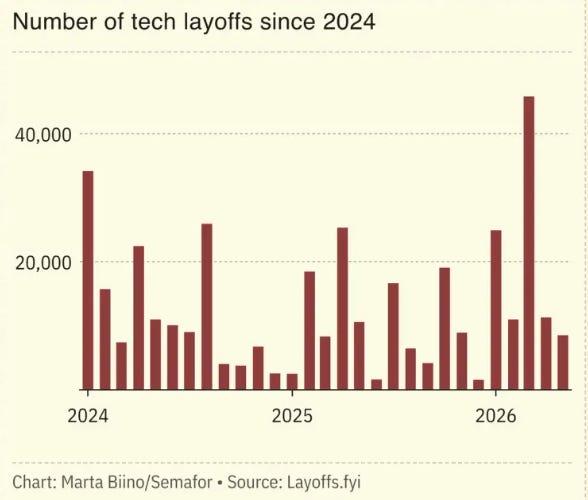
Graph that retained my attention this week