Structures in transition
N°15 - December 2025

As 2025 closes, this edition examines infrastructures reshaping beneath surface headlines, financial models, energy systems, and technological deployments transforming how capital flows and economies function.
African venture capital confronts structural misalignment. Aunnie Patton Power share that traditional 10-year models fail markets needing at least 13-17 years to mature, as African managers propose diverse architectures rather than replicating Silicon Valley’s standardised approach.
AI exits experimentation. Olivier Mathiot’s field research reveals deployment must unlock 10x capabilities rather than marginal gains, with hiring shifting from credentials to learning velocity. Florence Santrot reports Capgemini identifies 2026 as proof-of-impact year, with software entering “rebuild era” where intention replaces code. Yet Marina Temkin documents consumer AI’s “awkward teenage middle ground” whilst Howard Marks questions whether $1.4T circular investments constitute rational exuberance or necessary infrastructure financing.
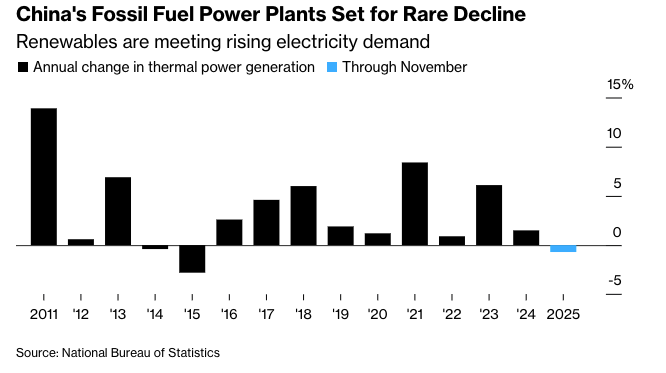
Energy sovereignty reshapes geopolitics. Tim McDonnell argues China’s $180B overseas green tech investment reveals transition as sovereignty strategy, creating new dependencies as countries find China the only viable supplier. Graham Readfearn shows Australian renewable grid would cut generation costs by third, whilst our Graph of the Week reveals China’s fossil fuel generation dropping for first time in decade.
Displacement accelerates. Daisuke Wakabayashi reports China nears first investment decline in three decades, whilst Kirsty Needham documents first Tuvalu climate migrants arriving Australia as NASA projects half of main atoll submerged by 2050. Florence Santrot offers counterpoint: WWF France shows protected species populations increased 120% since 1990.
Cécile Cazenave recommends six climate novels exploring transformed worlds as year-end reading.
We hope this curation will drive your own reflections and actions. Please feel free to share it with those who might be interested.
Happy holidays and see you in 2026! 💫
Insights
Aunnie Patton Power 🇬🇧 argues traditional 10-year, equity-only fund models fundamentally misalign with African market realities. Companies need 13-17 years to mature whilst most portfolio companies lack clear exit paths. The whitepaper reveals over 70% of deals rely on pure equity despite most startups being “phygital” requiring operational financing, as African fund managers propose diverse architectures including evergreen vehicles, dual equity/debt structures, and venture studios rather than replicating Silicon Valley’s standardised model, with collective action needed to build case for alternative designs creating more value for companies and investors. | LinkedIn post - RETHINKING VC
Olivier Mathiot 🇫🇷 argues AI has shifted from automation to competitive advantage, with field research across 11 founders revealing companies must hunt for 10x capability unlocks rather than marginal efficiency gains. His analysis shows Swile’s Loïc Soubeyrand and ClimateView’s Maxime Leroux require full traceability of AI decisions with documented prompts and human checkpoints, as Mathieu Nebra warns it’s never been easier to launch but just as easy to be disrupted, whilst hiring priorities shift from credentials to learning velocity as traditional junior pipelines disappear, prompting founders to redesign entry roles around AI stewardship where juniors learn judgment by explaining why they accept or reject AI suggestions. | 2050 - AI
Marina Temkin 🇺🇸 reports most consumer AI startups lack staying power as specialised applications disappear after platform integration, with Goodwater Capital’s Chi-Hua Chien comparing current state to pre-iPhone flashlight apps eventually absorbed by iOS. TechCrunch analysis shows Scribble Ventures’ Elizabeth Weil describes consumer AI in “awkward teenage middle ground” requiring new ambient devices beyond smartphones capturing only 3-5% of visual experience, though personalised financial advisers and tutors could succeed without new hardware whilst AI-powered social networks risk turning social interaction into “single-player game” by replacing human connection with bot interactions. | TechCrunch - CONSUMER AI
Howard Marks 🇺🇸 argues AI represents an “inflection bubble” where revolutionary technology accelerates infrastructure buildout through speculative investment, drawing parallels to 1860s railroads and 1990s internet whilst questioning whether current enthusiasm crosses into irrationality. Oaktree analysis shows AI firms committed $1.4 trillion in circular investments despite lacking profits, with $1 billion seed rounds for companies refusing to disclose products, as 30-year bonds finance uncertain technology whilst Oracle, Meta, and Alphabet leverage balance sheets through special-purpose vehicles reminiscent of Enron-era practices, though p/e ratios remain reasonable compared to 1998-2000 dot-com bubble suggesting current exuberance may prove rational if artificial general intelligence materialises. | Oaktree Capital - AI
Florence Santrot 🇫🇷 argues 2026 marks AI’s shift from proof-of-concept to proof-of-impact as Capgemini TechnoVision report shows companies must industrialise deployments after two years of experimentation. We Demain analysis identifies key trends: software entering “rebuild era” where intention replaces code, Cloud 3.0 emerging as hybrid sovereign environments after 8.5 million systems went offline in 2024, and autonomous value chains transforming operations through end-to-end orchestration, whilst “resilient interdependence” proves necessary as total tech sovereignty remains impossible with globally distributed AI components. | We Demain - TECH
Graham Readfearn 🇦🇺 reports CSIRO modelling shows 82% renewable Australian grid would generate electricity at $91 per megawatt hour by 2030 versus current $129 average, cutting generation costs by third whilst Coalition claims renewables drive price surges. The Guardian analysis shows 2050 electricity market could run almost entirely on renewables without cost increases, with battery prices dropping 15% this year following 20% fall previously, though completely emissions-free grid proves economically inefficient with report suggesting small fossil gas backup remains cheaper than green hydrogen whilst capturing CO2 elsewhere in economy, as offshore wind, carbon capture and nuclear all increase wholesale electricity costs. | The Guardian - ENERGY TRANSITION
Daisuke Wakabayashi 🇺🇸 reports China nears first annual investment decline in three decades after November dropped 11.1% year-on-year, with fixed-asset investment falling 2.6% January through November. The New York Times analysis shows real estate, public infrastructure, and manufacturing all declined simultaneously, an unusual confluence signalling deepening problems, as property crisis shakes confidence whilst local governments lack funds for public works and Beijing’s efforts to curb excessive competition slow factory investment, with retail sales rising just 1.3% at slowest pace in three years whilst China Vanke moves closer to default after failing to delay bond repayment. | The New York Times - CHINA
Tim McDonnell 🇺🇸 argues China’s $180B investment in overseas green tech projects since 2023 reveals energy transition as sovereignty strategy to break free from US-controlled fossil fuels whilst establishing new dependencies. Semafor analysis shows countries seeking cheaper predictable electricity increasingly find China the only viable supplier, creating energy security concerns as Western nations face choice between climate goals and strategic autonomy, with coal and gas-fired generation falling for first time since 2015 yet Trump administration viewing green claims as “information op,” as China borrows petrostate playbook to project geopolitical power through renewable infrastructure rather than emissions reduction alone. | Semafor - SOVEREIGNTY
Kirsty Needham 🇦🇺 reports first climate migrants from sinking Tuvalu arrived in Australia under 280-visa annual cap as over one-third of 11,000 population applied for climate migration programme launched two years ago. Reuters analysis shows NASA scientists project daily tides will submerge half of Funafuti atoll by 2050 with one-metre sea level rise, where 60% of residents cling to land as narrow as 20 metres, with worst-case two-metre rise putting 90% underwater, as Australian Foreign Minister Penny Wong describes visas offering “mobility with dignity” whilst Tuvalu Prime Minister emphasises maintaining cultural bonds as citizens including first female forklift driver, dentist, and pastor relocate thousands of kilometres from home. | Reuters - CLIMATE MIGRATION
Florence Santrot 🇫🇷 reports WWF France analysis of 248 protected species shows populations increased 120% on average since 1990, with species under National Action Plans growing six times faster than those with regulatory protection alone. We Demain analysis reveals flamingo populations quadrupled in Camargue whilst great myotis bat and black woodpecker doubled, yet 70% of countryside hedgerows disappeared with half of wetlands vanishing in one century, driving star bittern down 75% and Eurasian wigeon down 48%, as WWF identifies €37B in harmful subsidies requiring redirection towards restoration whilst cautioning wolf delisting and lynx’s limited 150-200 population with genetic diversity concerns threaten fragile conservation gains. | We Demain - BIODIVERSITY
Cécile Cazenave 🇫🇷 recommends six novels placing climate and biodiversity at heart of their narratives as year-end gift ideas, from Ananda Devi’s Le Jour des caméléons depicting Mauritius’s natural vengeance to Marion Brunet’s Ilos trilogy where teenagers fight for survival in 2052 Marseille partially submerged. Le Monde’s Chaleur humaine selection spans George Saunders’ curious fox learning human language to survive mall construction, Emmanuelle Salasc’s thriller set in 2056 Alpine glacier rupture under totalitarian ecological government, Bérengère Cournut and Laurine Roux’s fantastical nature explorations, and Pete Fromm’s autobiographical Rocky Mountains winter survival classic, offering readers imaginative frameworks for understanding transformed worlds. | Le Monde - MERRY CHRISTMAS
Graph of the week
China’s coal and gas-fired power plants are set to record their first annual generation decline in a decade, dropping 0.7% in 2025 according to National Bureau of Statistics data. Thermal output fell 4.2% in November as wind power jumped 22% and large solar farms rose 23% year-on-year. Source.